
Research College of Nursing is dedicated to institutional effectiveness.
Research College of Nursing (RCoN) is committed to a systematic, integrated approach to institutional effectiveness that supports student learning, promotes academic quality, and drives continuous improvement. Assessment activities are faculty-driven and grounded in the use of meaningful evidence to inform decision-making at the course, program, and institutional levels.
Through aligned processes of student learning assessment, program review, and institutional effectiveness monitoring, RCoN ensures that academic programs remain responsive to student needs, professional expectations, and the College’s mission.
General Education Assessment
The General Education Program at Research College is designed to provide students with an opportunity to enhance their capacity for intellectual inquiry and discovery, critical reasoning, and effective communication. These abilities are essential to assisting all students to become lifelong learners and provide them with the opportunity to be successful in their chosen fields. The goal of General Education assessment is to measure student learning outcomes for general education so continuous improvements to student learning can be made.
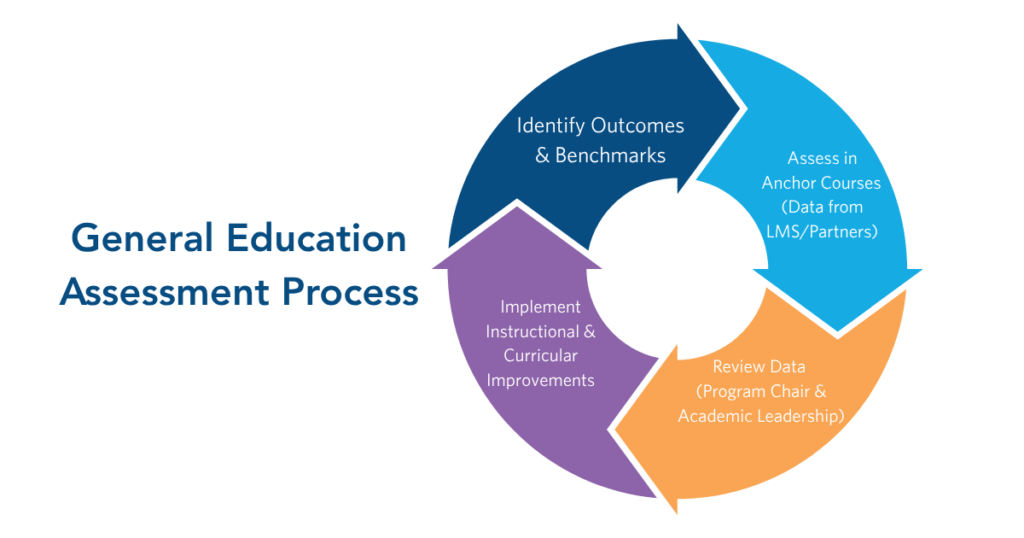
General Education assessment is the responsibility of the General Education chair and faculty members. Each of the four General Education Outcomes are threaded throughout the General Education courses. The General Education faculty, in collaboration with their program chair, designates learning activities that are specific to a given outcome and have been identified as a tool for the analysis of student learning. The faculty and chair then identify an expected level of achievement for each learning activity. The map below demonstrates which of the four General Education Outcomes are evaluated in each course.
The General Education Outcomes are analyzed by the General Education faculty and chair on a two-year cycle, and recommendations are made for course improvement. The General Education program is then evaluated every four years as part of the Internal Review process within the Institutional Effectiveness Council at Research College of Nursing.
General Education Learning Outcomes
- Critical Thinking: Students identify and evaluate sources of information, applying contextual evidence, knowledge, and multiple perspectives within the construction of their reasoning.
- Quantitative Reasoning: Students utilize analytical and scientific methodologies to identify, calculate, interpret, and analyze quantitative information.
- Self and Society: Students examine societal structures, concepts, and cultural perspectives to develop a deeper understanding of both self and society.
- Multimodal Communication: Students effectively express meaningful questions, ideas, and arguments through written, oral, and digital modes of communication.
Programmatic Assessment
The BSN program undergoes a comprehensive four‑year Internal Review cycle coordinated through the Evaluation Committee and Institutional Effectiveness Council (IEC). Based on programmatic accreditation requirements, the faculty have developed and continues to utilize ongoing assessment of programmatic outcomes for curricular improvements.
Retention, Persistence, and Graduation Rates
Research College’s retention, persistence, and graduation rates are below.
First Time Licensure Pass Rates and Completion Rates
Research College of Nursing’s first-time licensure pass rates for all of our programs compared to the national averages are below.
Our completion rates for each program below.
Results That Speak

Graduation Rates
This data reflects student persistence to successfully complete RCoN’s Traditional Bachelor of Science in Nursing (TBSN) and Accelerated Bachelor of Science in Nursing (ABSN) programs.
TBSN Completion Within Four Semesters
| Enrollment Year | 2020 | 2021 | 2022 | 2023 | 2024 |
|---|---|---|---|---|---|
| Enrolled | 93 | 85 | 68 | 66 | 50 |
| Retention Rate | 92% | 85% | 82% | 86% | 88% |
- TBSN Completion-4 Definition: Percentage of students who graduate within four semesters of beginning the program
- TBSN Completion-4 Benchmark: 70% in four semesters
TBSN Completion Within Six Semesters
| Enrollment Year | 2019 | 2020 | 2021 | 2022 | 2023 |
|---|---|---|---|---|---|
| Enrolled | 92 | 93 | 85 | 68 | 66 |
| Retention Rate | 97% | 95% | 85% | 92% | 83% |
- TBSN Completion-6 Definition: Percentage of students who graduate within six semesters of beginning the program
- TBSN Completion-6 Benchmark: 70% in six semesters
ABSN Completion Within One Year
| Enrollment Year | 2020 | 2021 | 2022 | 2023 | 2024 |
|---|---|---|---|---|---|
| Enrolled | 79 | 87 | 82 | 82 | 56 |
| Retention Rate | 95% | 93% | 89% | 94% | 96% |
- ABSN Completion-1 Definition: Percentage of students who graduate within one year of beginning program
- ABSN Completion-1 Benchmark: 80% in one year
ABSN Completion Within Two Years
| 2019 | 2020 | 2021 | 2022 | 2023 | |
|---|---|---|---|---|---|
| Enrolled | 59 | 79 | 87 | 82 | 82 |
| Retention Rate | 90% | 96% | 94% | 90% | 95% |
- ABSN Completion-2 Definition: Percentage of students who graduate within two years of beginning program
- ABSN Completion-2 Benchmark: 80% in two years
Hear From One Student
“The tuition forgiveness is incredible and life changing, and the foundation support as well. My mom was like — you’re going to RCoN.”
— Owen Phillips TBSN ’27

NCLEX Pass Rates
The National Council Licensure Examination (NCLEX) is the standard for entry into practice as a registered nurse. This table shows the percentage of RCoN BSN graduates who pass the exam on their first try.
BSN NCLEX First-Time Pass Rates
| 2021 | 2022 | 2023 | 2024 | 2025 | |
|---|---|---|---|---|---|
| RCoN1 | 89.7% | 79.2% | 90.4% | 94.1% | 89.6% |
| MO2 | 88.2% | 83.1% | 91% | 93.7% | 88.6% |
| US Baccalaureate3 | 86.1% | 82.3% | 90.2% | 91.9% | 87.6% |
Sources Last updated: 9/2/2026:
- 1Missouri State Board of Nursing/NCSBN “Report 4” Q4 Report (Annually)
- 2Nurse Licensure & NCLEX Exam Statistics (NCSBN)
- 3NCLEX Pass Rates, National Council of State Boards of Nursing (NCSBN)
Employment Rates
These statistics track the percentage of BSN graduates who secure employment in the nursing field within 12 months of graduation.
BSN Employment
| Graduation Year | 2021 | 2022 | 2023 | 2024 | 2025 |
|---|---|---|---|---|---|
| Employed | 100% | 100% | 100% | 100% | 100% |
DEU Program Provides Opportunities
“It’s a small environment here, it’s intimate. But there’s so much knowledge and there’s so much personal experience within the faculty. [The DEU program] gets you real-life experience at a great hospital!”
— Meredith Iden ABSN ’23
Retention Rates
RCoN students are committed to their education and get impactful support from the college. These figures show the percentage of students who continue their studies for the TBSN and ABSN programs.
TBSN Retention
| Enrollment Year | 2021 | 2022 | 2023 | 2024 | 2025 |
|---|---|---|---|---|---|
| Enrolled | 85 | 68 | 66 | 55 | 53 |
| Retention Rate | 89% | 85% | 88% | 93% | 98% |
- TBSN Retention Definition: Percentage of students who enroll in a course from 1st semester to 2nd semester
- TBSN Retention Benchmark: 85%
ABSN Retention
| Enrollment Year | 2022 | 2023 | 2024 | 2025 | 2026 |
|---|---|---|---|---|---|
| Enrolled | 82 | 82 | 56 | 39 | 125 |
| Retention Rate | 96% | 99% | 98% | 100% | 90% |
- ABSN Retention Definition: Percentage of students who enroll in a course from 1st term to 2nd term
- ABSN Retention Benchmark: 90%
Your Campus and Clinical Experience
-
Facilities & LaboratoriesHands‑On Learning Spaces

-
VisitPlan Your Visit
-
Dedicated Education UnitGet Immersive Training