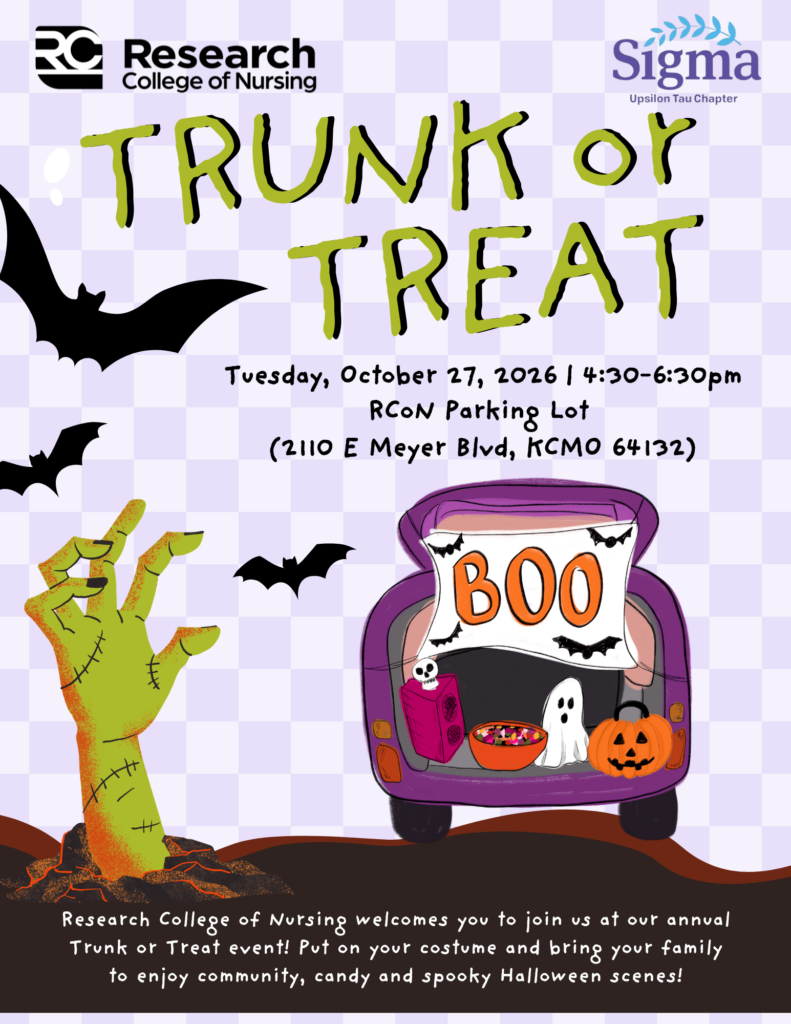
Research College of Nursing invites students, faculty, staff, alumni, and community members to join us for our annual Trunk or Treat event on Tuesday, October 27, from 4:30 to 6:30 p.m. in the RCoN parking lot.
This family-friendly tradition brings the community together for an evening of costumes, candy, and creatively decorated trunks. Guests of all ages are welcome to enjoy festive Halloween fun while connecting with fellow members of the Research College of Nursing community.
The event is organized in partnership with the Sigma Upsilon Tau Chapter and is free to attend.
Event Details
- Date: Tuesday, October 27, 2026
- Time: 4:30-6:30 p.m.
- Location: Research College of Nursing Parking Lot, 2110 E. Meyer Blvd., Kansas City, MO 64132
Come in costume, bring your family, and enjoy a spooktacular evening of community and celebration!
By: Rosemary Thompson, BSN, RN, Learning Skills Lab Coordinator
Every fall, as the weather begins to cool (finally!) and Halloween approaches, I look forward to one of my favorite community events of the year: Sigma’s Annual Trunk or Treat. While it may appear to be a simple afternoon filled with costumes, candy, and decorated trunks, for me it represents something much greater. It is a celebration of community, collaboration, service, and the power of people coming together to make a difference.
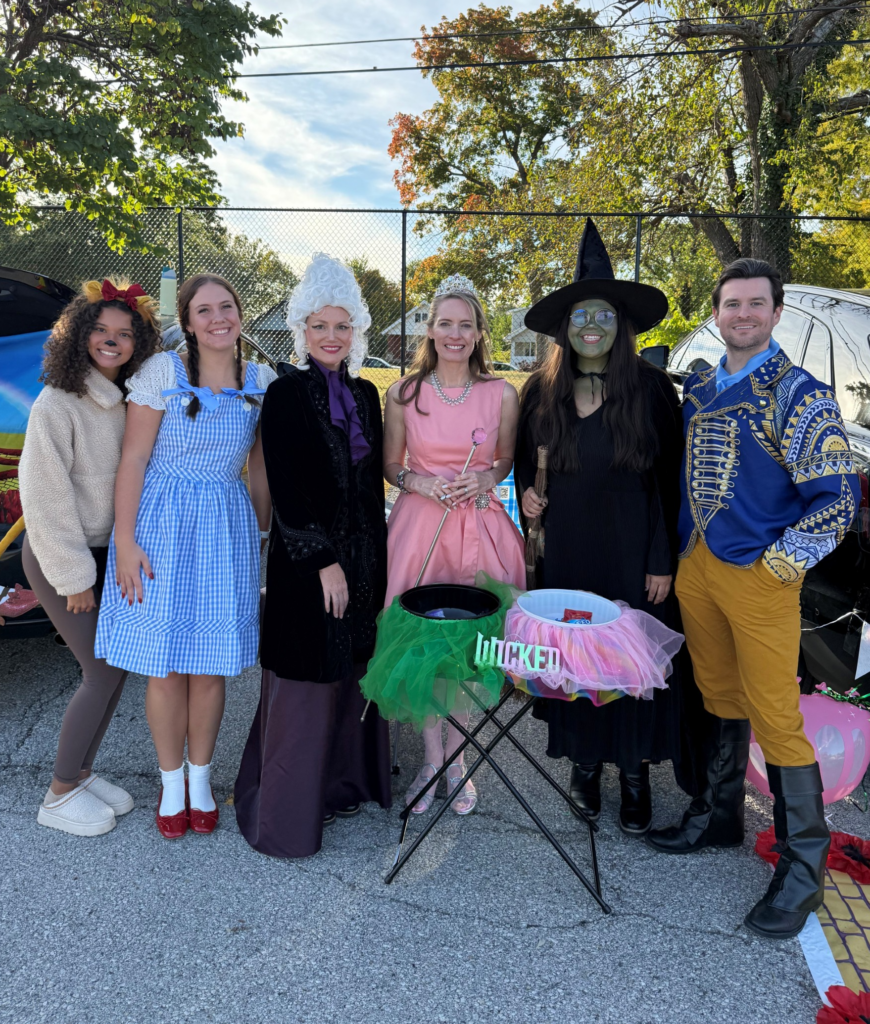
Having worked at Research College of Nursing for the past seven years and as a member of Sigma’s Upsilon Tau Chapter, the International Honor Society of Nursing, for the past five years, I have seen firsthand how both organizations are dedicated to fostering leadership, service, and community engagement. For the past two years, I have had the pleasure of co-chairing our Annual Trunk or Treat alongside the amazing Valerie Noack. Watching the event grow year after year, from a community outreach initiative into a tradition for local families, has been one of the most rewarding experiences of my career.
The Annual Trunk or Treat is a collaborative effort between Research College of Nursing and HCA Research Medical Center, bringing together nursing students, faculty, staff, and healthcare professionals around a shared goal: creating a safe, fun, and welcoming experience for children and families in our community. Faculty, staff, and students actively participate in planning and organizing the event alongside our hospital partners. This collaboration reflects our commitment to caring for the community beyond the classroom, simulation lab, and clinical setting as we donate our time, creativity and resources to making this event successful.
One of my favorite parts of planning the event is seeing the enthusiasm and generosity of our students and staff. Months before Halloween, students begin collecting candy donations, and what started as a friendly challenge has become a tradition many look forward to each year. Cohorts compete to see which class can collect the most candy, fostering teamwork, camaraderie, and a little friendly competition along the way.
Each year, our Director of Student Engagement, Ciara Wiegers, creates posters to support the effort. This year, Student Services Specialist Nikki Flagler and Research Student Governing Board members Anoush Zadoyan (TBSN M27) and Taylor Meyer (TBSN M27) have helped lead the student candy drive.
Beyond the fun, the candy drive reminds our future nurse leaders that service extends beyond patient care and that even small acts of generosity can make a meaningful difference. Candy donations come from students, faculty, and staff at Research College of Nursing, as well as departments and units across Research Medical Center. These contributions help ensure that every child who attends leaves with treats and a memorable experience.
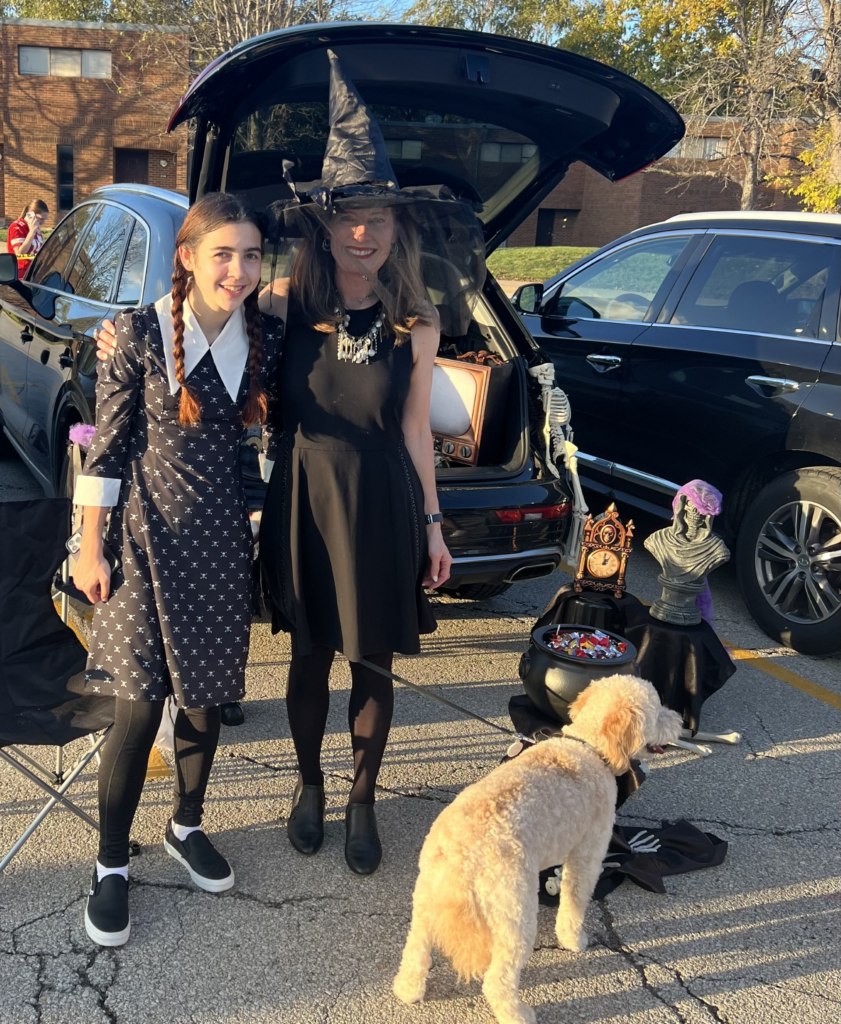
Community outreach is another cornerstone of the event. We invite surrounding schools, daycare centers, and community organizations to participate, helping us reach families throughout the area. Each year, we welcome both returning families and first-time attendees, and it is heartwarming to see the excitement on children’s faces as they arrive in costume.
The heart of Trunk or Treat is our volunteers. Most of the trunks are designed and staffed by nursing students who generously donate their time and creativity. Their imaginative themes transform a parking lot into a festive Halloween destination filled with games, decorations, and treats. We are also grateful for the participation of several hospital departments that contribute trunks and volunteers, helping create an even more engaging experience for the children and families who attend.
What may seem like a simple Halloween celebration is actually an opportunity to foster relationships, strengthen community connections, and create positive memories for local families.
Over the past four years, I have watched Trunk or Treat continue to grow. Last year, more than 350 people attended, including members of our local community and many HCA families. Attendance has increased each year, bringing more children, families, volunteers, and community partners together. With that growth has come an even stronger partnership among Sigma’s Upsilon Tau Chapter, Research College of Nursing, and HCA Research Medical Center. Together, we have created a tradition that not only provides a fun and safe event for children but also demonstrates the collective impact we can have when we work together in service to our community.
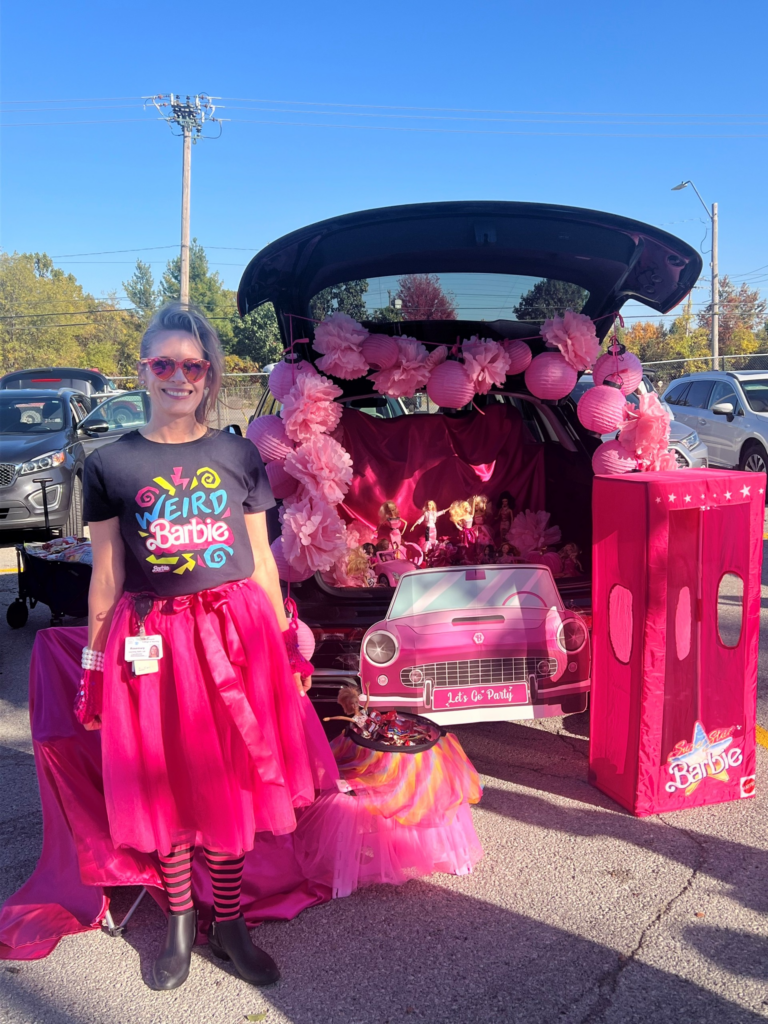
As I reflect on my involvement with Trunk or Treat, I am grateful for everyone who contributes to its success. The students who eagerly participate in candy drives, the faculty and staff who support planning efforts, the hospital departments that volunteer their time, and the community organizations that help spread the word all play a vital role. Their commitment embodies the mission of Sigma and reflects the caring spirit that defines both our college and hospital. While children may come for the candy and costumes, the true gift of Trunk or Treat is the sense of connection it creates. It brings together nursing students, healthcare professionals, educators, community organizations, and families for a shared experience centered on service and support. I am honored to have been part of this event for the past four years and to have served as co-chair for the last two. Watching it grow has been incredibly rewarding, and I look forward to seeing this meaningful tradition continue to impact our community for years to come. I hope to see many of you at our event this year (October 27 from 4:30-6:30 p.m.)!
By Stacie Withers, Director of Financial Aid
You already know it is full of confusing words, formulas, and acronyms. But here is the part most students do not realize financial aid is not one single award—it is a personalized package built just for you.
The Types of Aid You Can Receive from RCON
HCA Loan Forgiveness Program
Through the HCA Loan Forgiveness program, 75% of your tuition will be covered. In return, you commit to working for two years with HCA MidAmerica after graduation.
Federal Grants
Federal grants are exactly what they sound like—free money. These awards are based on financial need and do not have to be repaid. One important note: grants are for students working toward their first bachelor’s degree.
Federal Loans
Federal loans are funds you borrow now and repay later—with interest. The government helps secure better rates than you would find at a traditional bank.
A Few Things to Keep in Mind
- You are in control. You do not have to accept everything in your financial aid package. You can take only the grants (free money), some of the loans, or all of them. It is your aid, your decision.
- Grades matter more than you think. Poor academic performance can impact your eligibility for aid. Keeping your grades up helps ensure your awards stay intact.
- Financial aid is not “set it and forget it.” You will need to reapply every year to continue receiving aid. It is part of the process, and we are here to help you through it.
I am Here for You
Financial aid can feel overwhelming, but you do not have to navigate it alone. If you ever have questions—big or small—reach out anytime.
Stacie.withers@researchcollege.edu
By Dr. Amy Townsend, RCoN President
This summer marked a milestone for me personally: I have now been at Research College of Nursing for one year. In some ways, that year has gone very quickly. In others, it feels like I have been here much longer, mostly because so much has happened in a relatively short period of time.
When I arrived at RCON last summer, I knew I was joining a college with a long history of preparing students for meaningful careers in nursing. What I could not fully appreciate until I was here was the commitment of the people who make our work possible every day. Over the past year, I have had the opportunity to get to know our students, faculty, staff, alumni, and community partners, and I have learned a great deal by listening to their experiences and their ideas for the future of the college.
One of the things I have appreciated most is the willingness of people across RCON to think about what comes next. Colleges, especially those preparing students for careers in health care, cannot afford to stand still. The needs of our students are changing. The needs of the health care workforce are changing. Our responsibility is to make sure we are paying attention to both.
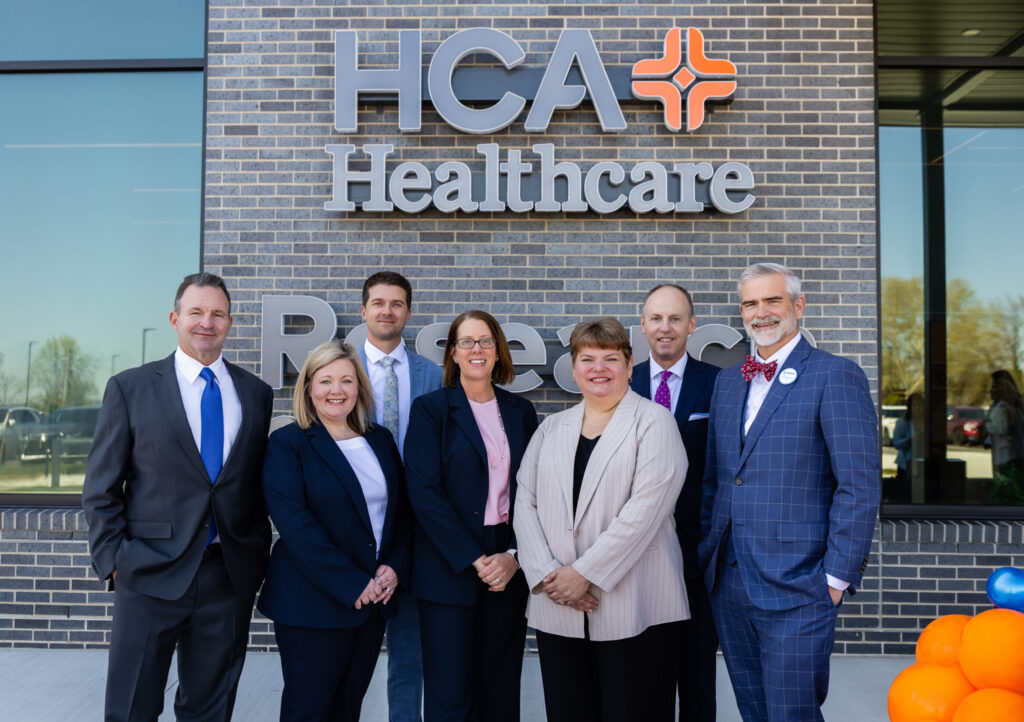
Over the past year, we have taken some important steps in that direction. We have continued to expand our nursing program and create additional opportunities for students pursuing careers in health care. We have also introduced fully online general education courses, giving students greater flexibility as they work toward completing their degrees. These changes are important, but I see them as a beginning rather than an end. There is more work ahead as we continue to consider how RCON can grow, evolve, and better serve our students and our community.
It is especially encouraging to begin this fall semester with our highest enrollment in several years. I am proud of that growth, but I know that enrollment numbers only tell part of the story. Behind every number is a student who made a decision to take a step forward. Some of our students are beginning college for the first time. Some have been working toward their degrees for several semesters. Others are balancing school with jobs, families, and responsibilities that do not stop simply because classes have started. Some know exactly where they want their careers to take them, while others may still be figuring that out. What they have in common is that they chose RCON to be part of that journey. I do not take that choice lightly.
Over the past year, I have also gained an even greater appreciation for the people who work here and how much happens behind the scenes to support a student from the day they first consider RCON through graduation and beyond. Faculty prepare students for classrooms, labs, clinical settings, and ultimately the responsibility of caring for patients. Staff work every day to make sure students have the support, resources, and opportunities they need to succeed.
As I reflect on my first year, I am proud of what we have accomplished, but I am probably even more excited about what I believe is possible. There are decisions still to make, opportunities still to explore, and certainly challenges we will have to work through. That comes with growth. My goal is not simply for RCON to grow for the sake of getting bigger. I want us to grow thoughtfully, in ways that create meaningful opportunities for students and respond to the needs of the health care communities we serve.

Now, as I begin my second year at RCON and we prepare for another fall semester, it feels like a natural time to look ahead. I have always loved this time of year because it feels like a new beginning. There is something about a new academic year, cooler mornings, changing routines, and, as one of my favorite movies reminds me, the appeal of a bouquet of newly sharpened pencils that makes it feel like a good time to reset and refocus.
Some members of our RCON community have been here throughout the summer, while others are returning after a break. New students are walking through our doors for the first time, returning students are picking up where they left off, and all of us are beginning another chapter together.
Last summer, I was the new person learning my way around, meeting people, asking questions, and beginning to understand RCON. A year later, I am still asking questions, but I have a much clearer picture of who we are, where our strengths lie, and where I believe we can go. I am so grateful to be part of this community and proud of the direction we are heading. I am thankful for the people who welcomed me, challenged me, shared their ideas, and helped me better understand what makes RCON special.
One year down. There is still a great deal ahead of us, and I am looking forward to it.
By Kirk McCarty, RN, MSN, CEO of Research Medical Center
At Research Medical Center, we often say that exceptional patient care begins with exceptional people. While advanced technology and innovative treatments are important tools in modern healthcare, our greatest strength has always been our caregivers – especially our nurses.
As the CEO, I have the privilege of seeing the impact nurses make every day. Their clinical expertise, compassion and dedication to serving others are at the heart of everything we do. That’s why our longstanding partnership with Research College of Nursing is so important, not only to the future of our hospital, but to the health and well-being of our community.
Year after year, Research College of Nursing has prepared highly skilled professionals who are ready to enter the workforce with confidence. Graduates bring a strong clinical foundation that allows them to transition quickly into practice. Many have already spent significant time alongside our teams as nursing students or nurse externs, gaining hands-on experience while becoming familiar with our patients, processes and culture. Through these experiences, they build meaningful relationships with colleagues and mentors long before they graduate.
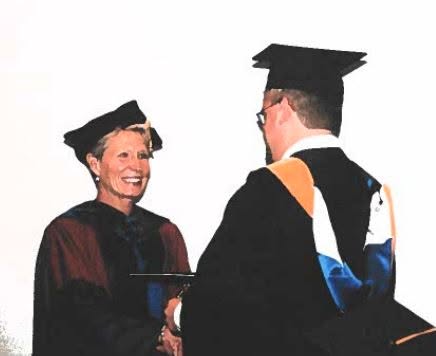
But what sets apart these graduates, is not just their clinical preparation. They bring a passion for nursing and a commitment to service that align perfectly with our mission at Research Medical Center: Above all else, we are committed to the care and improvement of human life.
In today’s healthcare environment, attracting and retaining talented nurses has never been more important. Hospitals across the country continue to navigate challenges that emerged following the COVID-19 pandemic. Through their academic programing and emphasis on real-world experience, Research College of Nursing helps meet the need by developing nurses who are not only clinically ready, but also well-equipped to thrive within Research Medical Center and across HCA Healthcare.
That is why I am always proud to see so many graduates choose to begin their careers with us. More than one out of every four graduates chose to continue their nursing journey here, a statistic that represents much more than a successful recruitment effort. It reflects the strength of a partnership that has endured for generations. The result is a steady pipeline of talented nurses who bring fresh perspectives, new ideas and an eagerness to learn, inspiring innovation and helping us continuously improve the care we provide.
As a Research College of Nursing alumnus myself, this partnership is especially meaningful for me. I have experienced firsthand the quality of education and preparation the college provides. I also know that today’s graduates represent the next generation of healthcare leaders. The bedside nurses caring for our patients today will become tomorrow’s charge nurses, educators, advanced practice providers and, as my own journey demonstrates, healthcare executives. I am confident our partnership will continue to strengthen our hospital, our profession and the health of our community for generations to come.
Why Jennifer Chose Nursing as a Second Career
By Ciara Wiegers
For many prospective students, nursing school is not the first chapter. It is the next one. It is a decision made after building a career, raising a family, and realizing you are ready for something more. Meet Jennifer, one of Research College of Nursing’s incredible student ambassadors, who is a powerful example of what it looks like to pursue nursing after living a full and busy life.
Jennifer grew up in a small town in southeast Oklahoma. She moved to Kansas City in 2017 and built a life filled with family, work, routines, and responsibilities long before she ever stepped into a nursing classroom. As a mom, choosing to leave her previous career required courage and a willingness to take on something new.

When she decided she was ready to pursue nursing, RCoN stood out right away, She shared that Karen Brooks, Academic Advisor, “was absolutely wonderful from the very beginning and made my next steps prior to acceptance very seamless. And the one-year ABSN program aligned well with my life.”
Her motivation for becoming a nurse comes from a deeply personal place. Jennifer explained, “I want to be the kind of person who cares for someone else’s family member the way I would want my own family cared for during difficult moments. This is out of appreciation for the caretaker that took care of my aunt while she was dying.” That experience shaped her understanding of compassion and strengthened her desire to be a source of comfort for others.
As a mom balancing school, home, and everything in between, Jennifer found something at RCoN she did not expect. She said, “Never have I ever had an educational experience feel this welcoming, seen, appreciated, valued, and supported.” She describes the faculty and staff as people who genuinely care, from the morning greetings at the front desk to instructors who encourage students every step of the way, IT staff who jump in quickly, and student engagement activities that make campus feel like a community rather than a place you simply pass through.

Jennifer stays involved by volunteering and serving as a Student Ambassador, finding connection and purpose in helping others navigate the same transition she made. Her advice for moms or anyone pursuing nursing after living life is simple and practical: “Get a planner. Stay organized so you stay on top of it.”
Jennifer’s journey is a reminder that nursing school is not only for those starting fresh. It is for those starting again with experience, perspective, and a deep sense of purpose. At RCoN, you are supported, encouraged, and welcomed exactly as you are.
By Jill Morsbach MSN, RNC-MNN,CNE
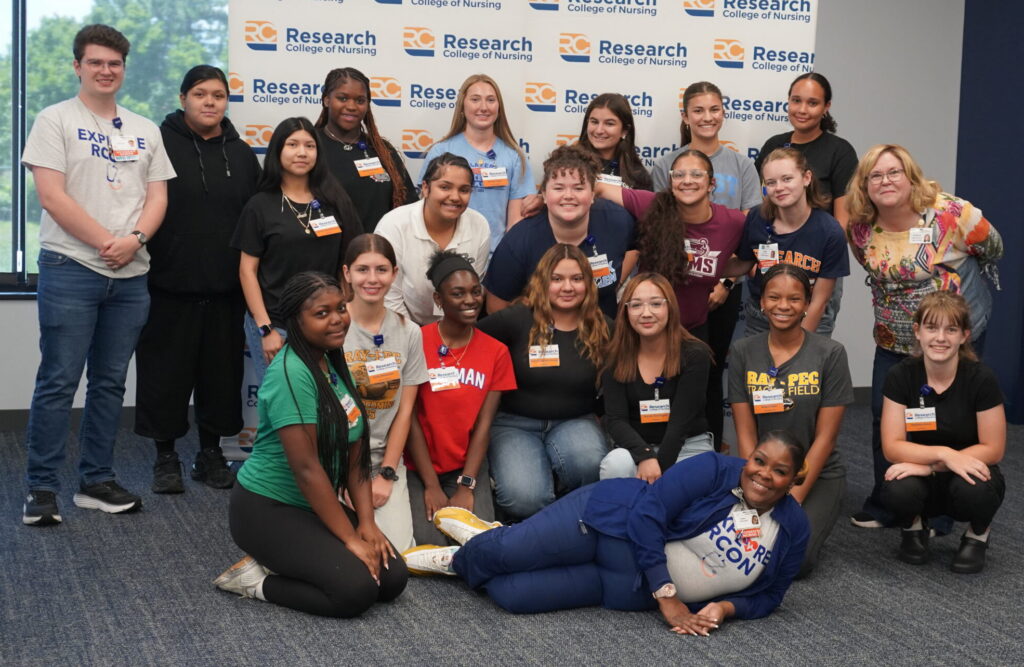
This year marked my third year coordinating Explore RCoN, and once again, I was reminded why this program is so special. On June 15, we welcomed 17 junior and senior high school students for three days of discovery, hands-on learning, and mentorship as they explored the incredible profession of nursing.
Day one was packed with activities! We began by answering important questions: What is a nurse? Where do nurses work? How much do nurses make? Students then spent time in our learning labs practicing injections, sterile gloving, and suture and staple removal. They also completed the Stop the Bleed® course and earned certificates. A tour of the radiology department introduced students to nursing roles in imaging, but the highlight of the day was a visit from the HCA transport helicopter and neonatal intensive care ambulance, where students learned about flight nursing and the many specialized roles involved in patient transport.
Day two allowed students to shadow nurses in their preferred specialties. Popular choices included the Emergency Department, ICU, Labor and Delivery, NICU, and Oncology. Watching students experience these environments firsthand and interact with practicing nurses was truly rewarding.
On our final day, students shared stories from their shadow experiences and spent time in the high-fidelity simulation lab before celebrating with a Kona Ice farewell. 🍧
While Explore RCoN requires a great deal of planning and coordination, the opportunity to connect with these students makes it all worthwhile. Some will return next year to explore a different specialty, and some may even become future students at Research College of Nursing. Whether they choose RCoN or another path, investing in the next generation of nurses is time well spent in service to our profession—and that is something worth celebrating. ❤️
By Pamelia O. Bertrand, PhD, MSN, RN
As nurses, we are trained to assess problems, develop plans, and implement solutions. Throughout our careers, we become skilled at identifying what needs to be fixed and taking action. While this approach serves us well in clinical practice, one of the most important lessons I learned through my research on peer support programs for healthcare workers is that not every situation requires a solution. Sometimes, what people need most is simply someone willing to listen.
Healthcare professionals experience emotionally challenging events throughout their careers. These experiences may include patient deaths, unexpected outcomes, medical errors, workplace violence, or other distressing situations. In the aftermath of these events, many individuals do not need advice or answers. Instead, they need a safe space to process their emotions, share their experiences, and feel understood.
During my doctoral research examining successful and sustainable peer support programs, one finding consistently emerged across participants from healthcare organizations nationwide: effective peer supporters prioritize listening over fixing. The ability to be present, listen actively, maintain confidentiality, and provide nonjudgmental support was consistently identified as more valuable than offering solutions.
This lesson extends far beyond healthcare settings. Whether we are supporting a colleague, student, family member, or friend, our first instinct is often to help by solving the problem. We offer suggestions, share similar experiences, or provide advice. While well-intentioned, these responses can sometimes unintentionally shift attention away from the individual who needs support.
Active listening requires us to slow down and focus fully on the other person. It means resisting the urge to immediately respond with advice and instead asking questions, validating emotions, and creating space for reflection. Often, people discover their own path forward when they feel heard and supported.
For nursing students, developing strong listening skills is just as important as developing clinical skills. Therapeutic communication, empathy, and compassionate presence are foundational components of nursing practice. These skills strengthen relationships with patients, improve teamwork, and contribute to healthier work environments.
As healthcare continues to evolve, the human connection remains at the heart of nursing. The ability to listen with empathy and without judgment may be one of the most powerful interventions we can offer.
Sometimes the greatest support we provide is not fixing a problem—it is simply being present for someone who needs to be heard.
Offering peer support is essential and should be the guide behind everything we do for our students, patients, family, and friends.
Always be there for one another.
NOTE: Dr. Pamelia Bertrand’s work on peer support for healthcare professionals was recently published in the Journal of Advanced Nursing. Her research explores how effective peer support programs prioritize active listening, empathy, and psychological safety to better support healthcare workers following emotionally challenging events.
To read more, click here.
By Valerie Noack
In January 2020, I began the accelerated BSN program at Research College of Nursing with equal parts excitement and nerves. Before nursing school, I had earned both a BA and an MA in English, so stepping into healthcare felt like the start of an entirely new chapter. I imagined spending the next year in hospitals, learning at the bedside, gaining confidence through hands-on clinical experiences, and gradually finding my place in the culture of nursing.
Instead, halfway through my first semester, the world shut down.
Like so many students during the COVID-19 pandemic, I left campus for spring break and never really returned in the same way. Hospitals, understandably, restricted student access as they focused on caring for patients during an unprecedented crisis. Almost overnight, many of the traditional clinical experiences we relied on disappeared.
So where did we learn?
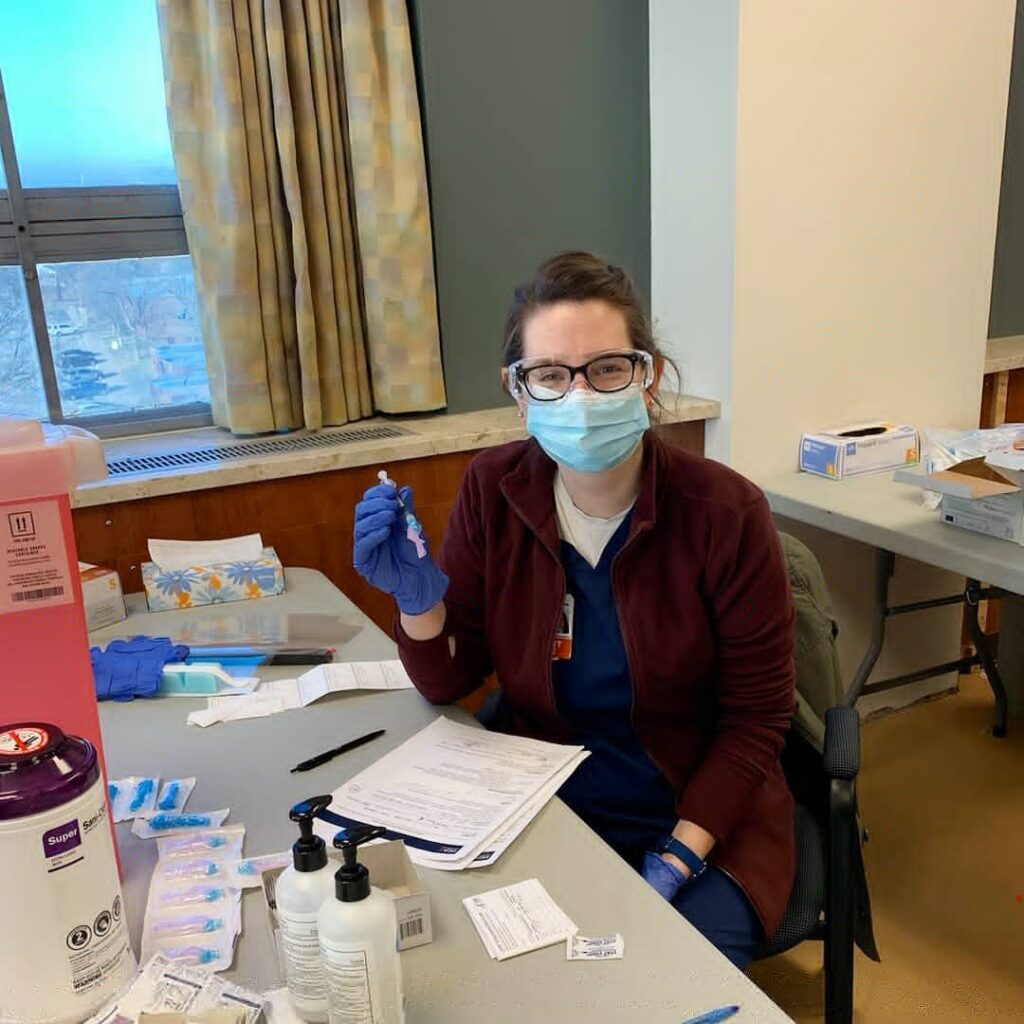
Simulation.
At first, that meant virtual simulations from home (think video game–style patient scenarios, but with nursing judgment and critical thinking at the center). Later, we returned to campus in masks, socially distanced, armed with enough purple disinfecting wipes to clean just about anything. When hospitals couldn’t safely accommodate students, simulation became the bridge between classroom learning and patient care.
At the time, I had no idea how much those experiences would shape my future.
As someone without prior hospital experience, simulation became my first real exposure to bedside nursing. It was where I developed psychomotor skills, learned how to communicate with patients, collaborated with teammates, and practiced clinical decision-making. When I graduated and began working as a floor nurse, many of the skills I relied on were first built in the simulation lab.
I still remember inserting my first Foley catheter on a real patient and thinking, I’ve done this on a mannequin before. I can do this on a human.
That confidence mattered.
Simulation gave me a safe space to practice before the stakes became real. It allowed me to make mistakes, ask questions, and grow without the fear of harming a patient. And honestly, that’s still what I love most about simulation. It’s one of the only places in nursing education where students can learn through trial and error—because while the “patients” aren’t real, the learning absolutely is.
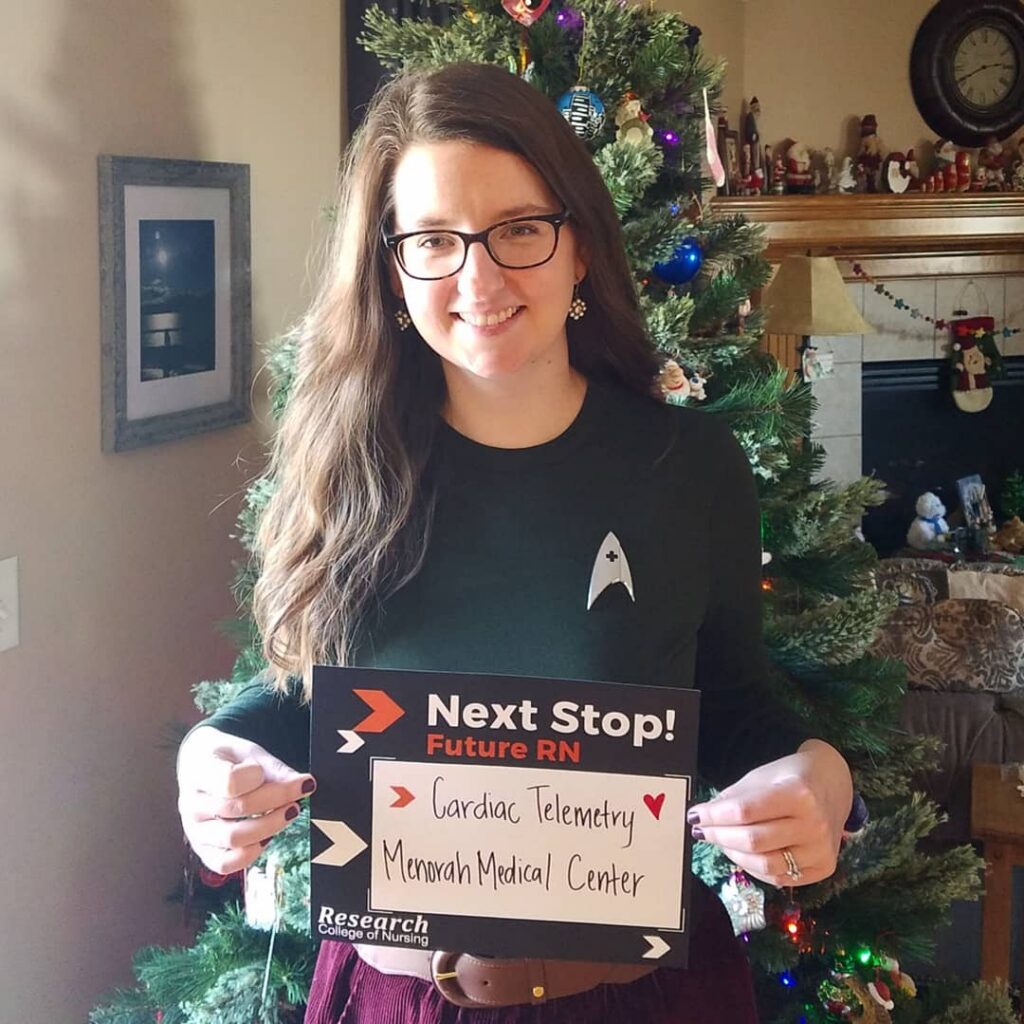
After graduating in December 2020 (via Zoom, from my parents’ kitchen table), I worked as a bedside nurse and later as a case management through career growth opportunities within HCA Healthcare. Each role taught me something valuable, but it wasn’t until I saw an opening for simulation director back at Research College of Nursing that everything clicked.
Coming back to the college where I trained has been both healing and inspiring. I missed out on many traditional college experiences during the pandemic, so being able to watch today’s students participate in clinicals, white coat ceremonies, campus events, and in-person graduations feels especially meaningful.
What continues to set Research College of Nursing apart is its people. As a student, I felt deeply supported by faculty and staff who were determined to help us succeed despite impossible circumstances. Now, as simulation director, I strive to give students that same sense of support. We challenge them, yes, but we also remind them that learning is a process.
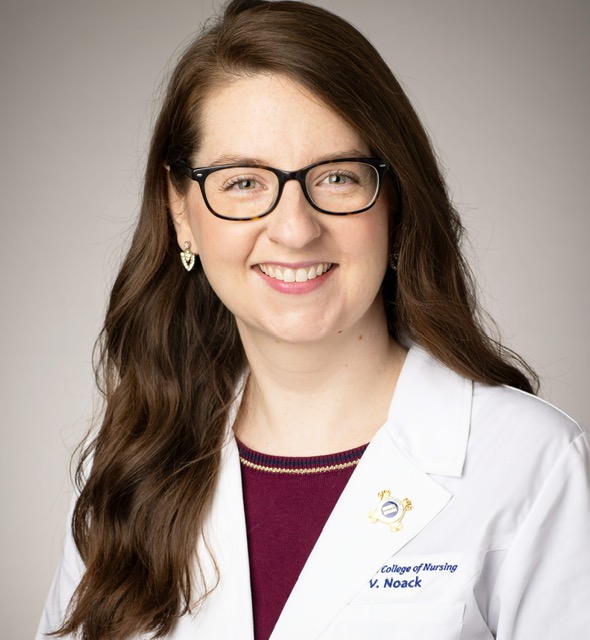
Nursing is hard. It’s meaningful, rewarding, and sometimes overwhelming. But one of the greatest lessons I’ve learned is that every experience becomes a tool you carry forward with you. You never know where your nursing path may lead, and you never know when those old tools may come in handy.
For me, Research College of Nursing became more than a school—it became home. And now, I have the privilege of helping the next generation of nurses discover what they’re capable of, too.
By Ciara Wiegers
There’s a moment at the start of every year that never loses its magic. Orientation morning. Students walk in with nervous smiles, a caffeinated beverage, and the kind of hope you can feel before they even say a word. They don’t know where anything is yet. They don’t know each other. They don’t know what’s coming. But I do. And every time, I feel lucky to witness the beginning of their story.
As Director of Student Engagement, I get to see their journey from a perspective that feels almost like a privilege. I’m not their instructor or their clinical supervisor. I’m the person who shows up to their first lab with a camera in hand, ready to capture the moment they put on gloves, take their first vitals, or practice a skill they’ve been nervous about all week. I get to watch their confidence grow frame by frame, semester by semester.
I see the friendships forming in real time. The laughter during Welcome Week. The inside jokes that start in the hallway. The way they show up for each other in labs, in study rooms, and in the middle of long days when everyone is exhausted but still pushing forward. I see the spark when they realize they’ve found their people.
And I see the hard moments too. The ones that don’t make it into photos. I’ve had students cry in my office because life didn’t pause just because school got hard. I’ve watched them navigate loss, heartbreak, financial stress, and moments where they weren’t sure they could keep going. I’ve seen students become parents, sometimes again, balancing bottles and textbooks with a strength that leaves me in awe.
What they don’t always realize is that they’ve supported me too. They’ve made me laugh on days when I needed it more than they knew. They’ve reminded me why this work matters, why community matters, and why showing up for people matters.
And then, somehow, we arrive at graduation.
I watch them line up in their regalia, the same students who once wandered around Orientation trying to find the right room. Now they stand tall, ready to walk across a stage that represents every late night, every ATI exam, every tear, and every triumph. When their name is called, I don’t just see a graduate. I see the whole journey. The courage. The growth. The resilience. The becoming.
It is one of the greatest honors of my career to walk beside them from that first nervous hello to the moment they step into the world as nurses. Every class leaves a mark on me. Every student teaches me something about strength, compassion, and what it means to keep going even when it’s hard.
This work is not just my job. It’s my honor.